☕ Monday Morning Barrel | June 15, 2026
Wildcatters EditorialGood morning.
If you spent the weekend trying to avoid headlines, you picked the wrong weekend.
Washington spent another week debating America's role in the Middle East. Oil traders watched every update crossing from the Persian Gulf. President Trump celebrated his 80th birthday amid military commemorations and appearances that once again highlighted his influence over American politics. New Yorkers woke up celebrating a championship they had waited more than half a century to see. Meanwhile, Wall Street continued wrestling with a question that increasingly affects everyone from technology investors to oil producers: where will all the energy come from to power the next phase of economic growth?
At first glance, these stories appear unrelated.
They're not.
In many ways, nearly every major headline this week came back to one theme: reliability.
Reliable energy.
Reliable infrastructure.
Reliable supply chains.
Reliable returns.
And nowhere was that more apparent than in the energy markets.
Energy Security Is Back
For much of the past decade, investors worried about whether the world would need less oil.
Electric vehicles were expected to reduce gasoline demand. Renewable energy investment surged. ESG mandates pushed billions of dollars away from traditional energy companies. The dominant narrative wasn't whether the world would have enough oil and gas, but whether the industry would eventually produce too much of it.
This week served as a reminder that the global economy still operates under a far simpler reality.
Economic growth requires reliable energy, and reliable energy remains surprisingly difficult to secure.
The biggest energy headlines of the week all pointed toward the same conclusion. Traders spent days trying to determine how much oil was actually at risk following disruptions tied to Iran and the Strait of Hormuz. Initial estimates suggested global markets could lose more than 10 million barrels per day of supply. By week's end, Reuters reported that shipping companies and commodity traders believed the actual losses would likely be much smaller, perhaps closer to five million barrels per day as producers rerouted cargoes and alternative supply chains emerged.
The fact that markets reacted so aggressively despite ultimately smaller supply losses tells us something important. Traders are increasingly concerned not just about production, but about flexibility. Global inventories remain relatively tight, spare capacity is concentrated in a handful of countries, and geopolitical disruptions continue arriving faster than markets can comfortably absorb them.
The issue isn't whether the world has oil.
The issue is whether the world has enough immediately available oil when something goes wrong.
America's Energy Position Has Never Been Stronger
That concern is increasingly benefiting the United States.
One of the most consequential developments of the week received surprisingly little mainstream attention: America is now the world's largest oil exporter.
Reuters reported that U.S. crude exports reached approximately 10.5 million barrels per day, surpassing both Saudi Arabia and Russia. Twenty years ago that statistic would have sounded absurd. Today it is a reminder of how dramatically the shale revolution reshaped global energy markets.
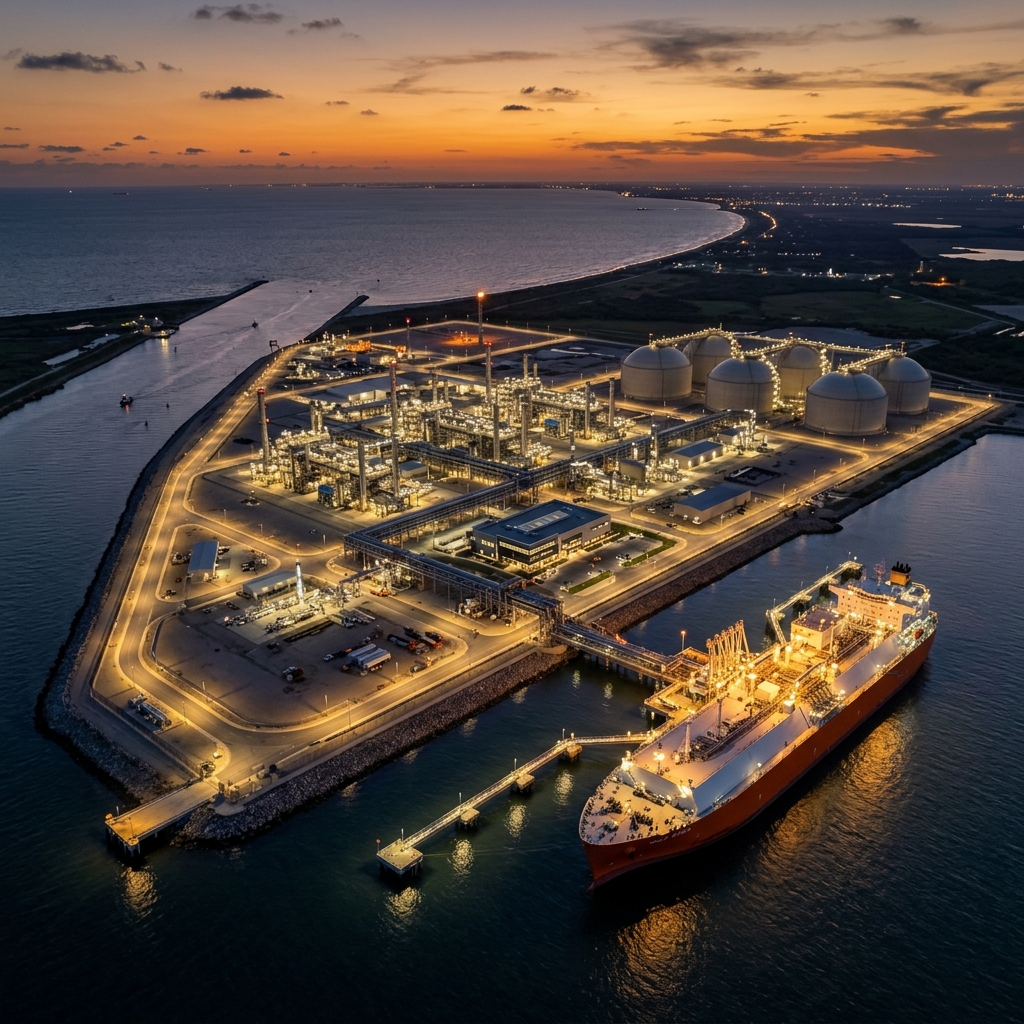 Figure 1: An aerial view of a major LNG export and liquefaction terminal on the U.S. Gulf Coast with an LNG carrier ship docked at the pier. America's record-breaking export capacity serves as a global anchor for energy security. Source: Gulf Coast Operations / Maritime Intelligence.
America was once viewed primarily as an energy consumer vulnerable to foreign supply disruptions. Today, it sits at the center of global energy markets.
When international supply becomes uncertain, buyers increasingly turn toward U.S. barrels.
When LNG demand rises, global markets increasingly depend on Gulf Coast export facilities.
When geopolitical tensions threaten shipping lanes, American production becomes more valuable.
That reality is creating opportunities throughout the industry, from large public producers to independent operators, mineral owners, brokers, landmen, and investors looking for exposure to long-term energy demand.
Wall Street Wants Energy. Just Not the Old Version.
Perhaps the most interesting development isn't what energy companies are doing.
It's what they're not doing.
Historically, oil prices at current levels would have triggered a surge in drilling activity. Instead, Baker Hughes reported this week that the U.S. rig count declined for the first time in nearly two months.
That's a remarkable shift.
For years, the shale industry was built on growth. Higher prices meant more rigs. More rigs meant more production. More production meant more capital.
Today's industry operates differently.
Public companies are prioritizing free cash flow. Investors are demanding returns. Management teams are focused on balance sheets instead of production records.
The result is an industry behaving with far more discipline than it did during previous cycles.
That discipline is also showing up in dealmaking.
Capital continues flowing into energy, but investors are becoming increasingly selective. Rather than funding speculative drilling programs, money is moving toward producing reserves, mineral interests, infrastructure, royalties, and natural gas assets tied to long-term demand growth.
One example came this week when Reuters reported that commodities trader Gunvor is backing a new acquisition platform focused on U.S. natural gas assets.
The transaction itself isn't the headline.
The thinking behind it is.
Investors are increasingly buying cash flow rather than forecasts.
The Natural Gas Story Keeps Getting Bigger
Oil still dominates headlines.
Natural gas may be becoming the more important investment story.
The EIA expects U.S. natural gas production and demand to reach record levels over the next several years, supported by LNG exports, power generation, industrial growth, and electricity demand.
What makes this trend particularly interesting is where demand is coming from.
Data centers.
Artificial intelligence.
Manufacturing.
Grid reliability.
LNG exports.
These are not short-term trends.
They represent structural demand growth that could last for years.
Natural Gas Intelligence even explored whether SpaceX's long-term ambitions could eventually become meaningful enough to influence domestic natural gas demand, a reminder that future energy consumption may come from industries few people were discussing a decade ago.
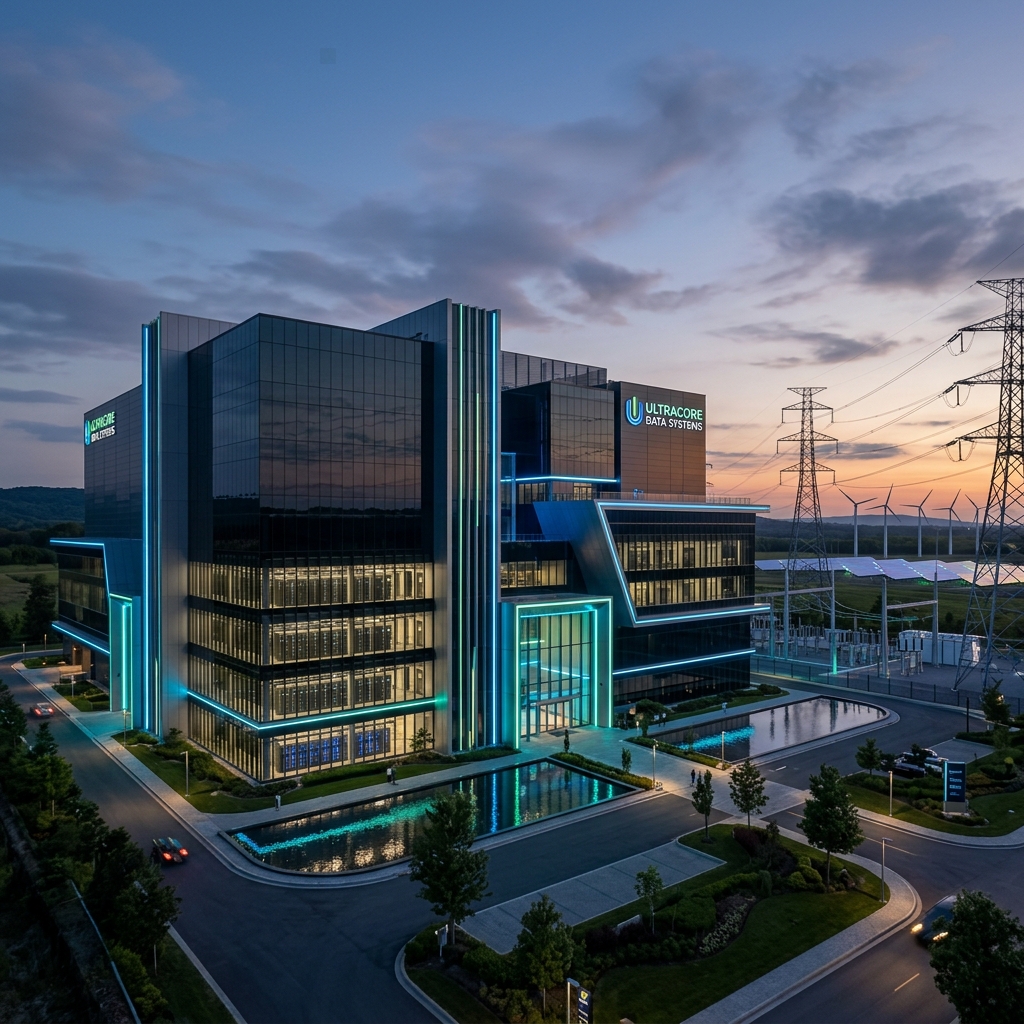 Figure 2: A modern sleek data center facility located near electrical power transmission lines. Exponential growth in artificial intelligence and data center operations is driving long-term structural demand for reliable natural gas power generation. Source: Grid Technology Review.
The broader takeaway is straightforward.
Oil remains critical.
Natural gas increasingly looks strategic.
Why This Matters for Independent Operators
For Wildcatter readers, this may be the most important section of all.
The headlines are dominated by Exxon, Chevron, Shell, and billion-dollar transactions.
The opportunities often are not.
As large operators consolidate, they inevitably create non-core assets. Producing properties that don't move the needle for a supermajor can still represent meaningful opportunities for independent operators. The same applies to mineral packages, water infrastructure, non-operated interests, and mature producing fields.
This is where brokers, landmen, family offices, and independent operators continue creating value.
The public market sees scale.
The private market sees opportunity.
A landman identifies fragmented mineral ownership.
A broker finds a seller before a formal process begins.
A local operator understands the economics of a mature field better than anyone sitting in a New York conference room.
Those advantages don't show up in quarterly earnings reports, but they continue driving a significant portion of activity across the oil patch.
In a market increasingly focused on cash flow and asset quality, local knowledge may be becoming more valuable, not less.
Around the Country
Outside energy, the country wasn't exactly quiet.
President Trump marked his 80th birthday over the weekend, drawing national attention and reminding everyone that regardless of political affiliation, he remains one of the most influential figures shaping policy discussions heading into the second half of his presidency.
In sports, the Knicks completed one of the most improbable championship runs in modern NBA history, delivering New York its first title since 1973. Somewhere in Manhattan, hedge fund managers are celebrating. Somewhere in Dallas, people are wondering how exactly this happened.
Meanwhile, investors continued pouring billions into artificial intelligence infrastructure, data centers, and power generation projects, creating yet another connection between technology and energy markets. Every AI breakthrough ultimately requires electricity, and increasingly, the companies supplying that electricity are becoming just as important as the companies building the software.
Five Links Worth Reading
America Becomes the World's Largest Oil Exporter https://www.reuters.com/business/energy/once-an-arab-oil-embargo-victim-us-becomes-worlds-top-oil-exporter-2026-06-11/
Lost Gulf Oil Exports Smaller Than Feared https://www.reuters.com/business/energy/lost-gulf-oil-exports-far-smaller-than-thought-traders-shippers-say-2026-06-12/
Gunvor Backs U.S. Gas Acquisition Platform https://www.reuters.com/legal/litigation/commodities-trader-gunvor-funds-venture-buy-us-natural-gas-production-2026-06-10/
U.S. Natural Gas Output and Demand Expected to Hit Records https://www.reuters.com/business/energy/us-natgas-output-demand-hit-record-highs-2026-eia-says-2026-06-09/
EIA Short-Term Energy Outlook https://www.eia.gov/outlooks/steo/
Final Thought
The biggest takeaway from this week isn't that oil prices moved higher or that another geopolitical flashpoint emerged overseas.
It's that the world continues to pay a premium for reliability.
Reliable energy.
Reliable infrastructure.
Reliable supply chains.
Reliable returns.
Whether you're a Permian operator, a mineral owner in Oklahoma, a landman in Appalachia, a broker in Houston, or an investor sitting in Manhattan, the market is increasingly rewarding the same thing: certainty in an uncertain world.
We'll see if that remains true next week.