The Weekly Barrel: U.S. Energy Had a Strange Week. Prices Rose, Rigs Fell, Gas Capital Moved, and the Market Got More Selective.
U.S. energy drillers pull back on gas rigs while crude prices hold on global supply concerns, and private capital targets high-margin gas infrastructure.
The U.S. energy market sent a mixed message this week.
Oil prices stayed supported by geopolitical risk and tight inventories, but U.S. drillers still pulled back. Natural gas demand forecasts moved higher, but gas rigs fell. Major companies kept reshuffling portfolios, while private capital continued looking for assets tied to LNG, power demand, and long-term gas growth.
That tension is the real story.
The market is not saying oil and gas are weak. It is saying capital has become selective.
Reuters reported Friday that U.S. energy firms cut the number of active oil and gas rigs for the first time in eight weeks. The total rig count fell by one to 562, according to Baker Hughes. Oil rigs rose by two to 433, the highest level since June 2025, while gas rigs fell by three to 121, the lowest level since October 2025.
Source:
https://www.reuters.com/business/energy/us-energy-firms-cut-rigs-first-time-eight-weeks-baker-hughes-says-2026-06-12/
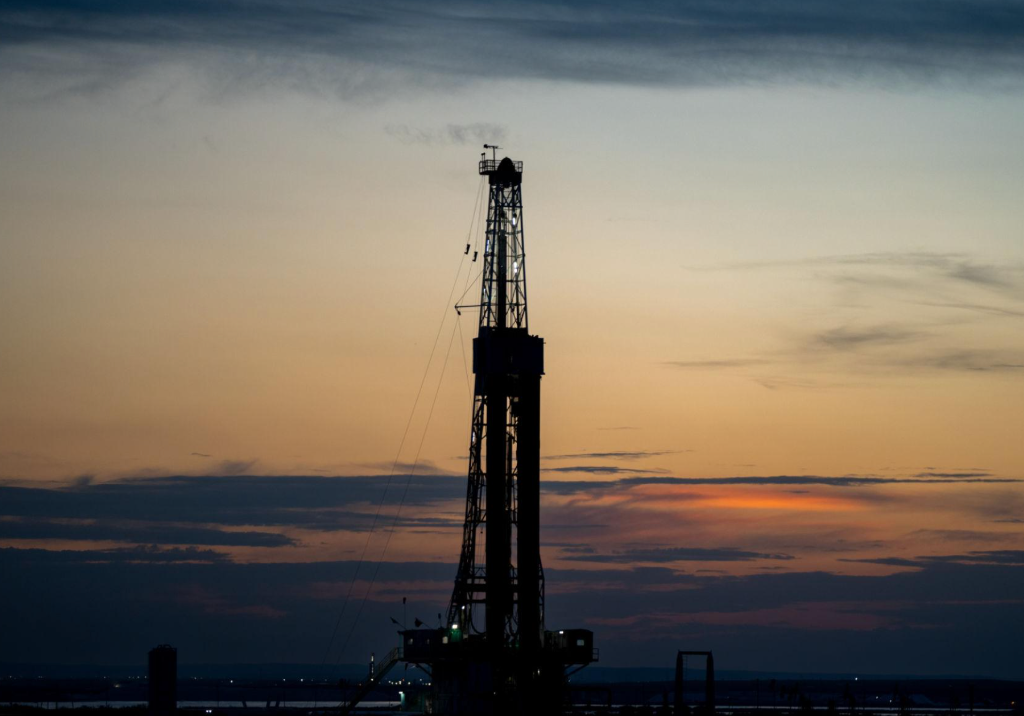
*Figure 1: A drilling rig silhouette at sunset. The U.S. rig count declined for the first time in eight weeks, driven by a reduction in gas-directed rigs despite elevated crude prices. Source: Baker Hughes / Field Operations.*
That is not what a classic boom looks like.
In previous cycles, higher crude prices usually meant a faster drilling response. Operators added rigs, service companies got busy, and capital chased growth. This time, even with oil supported by global supply risk, the industry is still behaving carefully.
Part of that caution comes from economics. Borrowing costs remain higher than they were during the last shale expansion. Labor, services, steel, insurance, and equipment are still expensive. Public companies also remain under pressure to return cash to shareholders rather than chase production growth.
So the current market is not just about the price of oil. It is about margin.
A $90 barrel can still disappoint if lease operating expenses, financing costs, and infrastructure constraints eat too much of the return. That is especially true for smaller independent operators, where one bad workover, one gathering issue, or one refinancing problem can change the economics of an entire package.
At the same time, the global supply picture remains tight enough to keep traders nervous. Reuters reported this week that the feared loss of Gulf oil exports tied to Middle East disruptions appears smaller than many expected. Early estimates suggested the market could lose 12 million to 15 million barrels per day. Traders and shippers now believe the shortfall may be closer to 5 million to 6 million barrels per day, partly because barrels are still moving through alternative routes.
Source:
https://www.reuters.com/business/energy/lost-gulf-oil-exports-far-smaller-thought-traders-shippers-say-2026-06-12/

*Figure 2: An oil tanker navigating international waters. Rerouted crude shipments and emergency logistics are keeping global supply flowing, albeit at significantly higher transportation costs. Source: Maritime Intelligence.*
That does not mean the market is comfortable.
It means the market is adapting.
The problem is that adaptation often comes through inventory draws, emergency logistics, rerouted cargoes, and higher costs. In other words, the system may be functioning, but it is not functioning cheaply.
That is why the U.S. matters more now than it did in previous oil shocks. American production, Gulf Coast exports, LNG infrastructure, and private-market oil and gas assets are increasingly tied to global energy security. The U.S. is not just reacting to global supply disruptions anymore. It is one of the places buyers look when those disruptions happen.
The national data reinforces that point. The EIA's June Short-Term Energy Outlook shows U.S. natural gas production and demand both moving toward record levels. Reuters reported that dry gas production is expected to rise from 107.7 Bcf/d in 2025 to 111.0 Bcf/d in 2026, while LNG exports are expected to climb from 15.1 Bcf/d in 2025 to 17.2 Bcf/d in 2026.
Source:
https://www.reuters.com/business/energy/us-natgas-output-demand-hit-record-highs-2026-eia-says-2026-06-09/
That is one of the biggest stories in energy right now.
Oil still gets the attention, but gas is where a lot of long-term capital is looking. LNG exports, data centers, power generation, industrial demand, and global energy security are all pushing investors to think differently about U.S. natural gas.
Even SpaceX fits into that conversation.
Natural Gas Intelligence published a piece this week asking whether SpaceX's ambitions could eventually become large enough to affect Lower 48 natural gas demand. That is not a conventional oil and gas headline, but it points to something important: future gas demand may come from places the industry was not underwriting five years ago. Space launches, AI data centers, manufacturing, grid reliability, and electrification are all becoming part of the energy demand story.
Source:
https://naturalgasintel.com/news/could-musks-spacex-ambitions-eclipse-current-lower-48-natural-gas-demand/
This is why private capital keeps circling gas assets.
Reuters reported this week that commodities trader Gunvor is backing Western Natural Resources, a private Oklahoma City-based company, to acquire U.S. natural gas-producing assets. Western recently acquired about $300 million of Haynesville gas assets from Nadel and Gussman NV and Quantent Energy Partners.
Source:
https://www.reuters.com/legal/litigation/commodities-trader-gunvor-funds-venture-buy-us-natural-gas-production-2026-06-10/
That deal is worth watching because it shows how capital is thinking.
Investors are not just buying wells. They are buying exposure to a system: gas supply, LNG exports, power demand, and infrastructure. That is a different pitch than simply saying "we can drill more."
For independent operators, brokers, landmen, and mineral owners, this is the lesson of the week. The market wants energy exposure, but it wants it underwritten properly. Clean title matters. Netbacks matter. Basis exposure matters. Decline curves matter. Infrastructure matters. So does the ability to explain how investors get paid back.
The big companies are making the same calculation at a larger scale.
Reuters reported Friday that BP has started the process of selling minority stakes in two Gulf of Mexico projects, Kaskida and Tiber. Both are major offshore developments expected to produce about 80,000 barrels per day, with Kaskida expected online in 2029 and Tiber in 2030.
Source:
https://www.reuters.com/world/bp-starts-process-sell-stakes-two-gulf-mexico-projects-sources-say-2026-06-12/
That is not BP exiting oil. It is portfolio management.
The same thing showed up at Shell. Reuters reported that Shell paused a $3 billion share buyback ahead of a shareholder vote tied to its proposed $16.4 billion acquisition of ARC Resources, a Canadian gas producer connected to Shell's LNG strategy.
Source:
https://www.reuters.com/business/shell-pauses-3-billion-share-buyback-2026-06-12/
These are large-company moves, but they reflect the same market logic facing smaller operators.
Capital is moving toward quality assets, long-life reserves, gas exposure, infrastructure, and cash flow. It is moving away from vague growth stories.
That creates an opening for the middle market of oil and gas.
As public companies get bigger, they also get more focused. Assets that are too small, too scattered, or too mature for a major operator may still be attractive to a private buyer. A 200-barrel-per-day package may not matter to a public company, but it can matter to a family office or independent operator. A mineral package with fragmented ownership may not fit an institutional process, but it may be exactly the kind of opportunity a good landman can assemble.
This is where Wildcatter's audience sits.
The best opportunities in this market may not be the most obvious ones. They may be mature producing assets, non-op interests, minerals, water infrastructure, gas-heavy positions, or overlooked properties that need a better operator and a realistic capital plan.
The mistake is thinking higher oil prices automatically make everything financeable.
They do not.
The better way to raise money in this market is to lead with discipline. Show current cash flow. Show operating costs. Show decline history. Show infrastructure access. Show what happens at lower prices. Show the use of proceeds. Show why the asset survives if the market turns.
Investors are not allergic to oil and gas. They are allergic to sloppy underwriting.
That may be the main takeaway from the week. Energy is becoming more important globally, but capital is becoming more demanding locally. Oil prices are supported. Gas demand is growing. LNG remains strategic. Big companies are reshuffling portfolios. Private capital is buying assets. But nobody wants to fund another undisciplined boom.
For independent operators, that is not bad news.
It means the advantage may belong to the people who know their assets best.
### Top Reads of the Week
U.S. energy firms cut rigs for first time in eight weeks
https://www.reuters.com/business/energy/us-energy-firms-cut-rigs-first-time-eight-weeks-baker-hughes-says-2026-06-12/
Lost Gulf oil exports smaller than initially feared
https://www.reuters.com/business/energy/lost-gulf-oil-exports-far-smaller-thought-traders-shippers-say-2026-06-12/
U.S. natural gas output and demand expected to hit record highs
https://www.reuters.com/business/energy/us-natgas-output-demand-hit-record-highs-2026-eia-says-2026-06-09/
Gunvor backs U.S. natural gas acquisition platform
https://www.reuters.com/legal/litigation/commodities-trader-gunvor-funds-venture-buy-us-natural-gas-production-2026-06-10/
BP starts process to sell Gulf of Mexico project stakes
https://www.reuters.com/world/bp-starts-process-sell-stakes-two-gulf-mexico-projects-sources-say-2026-06-12/
Shell pauses buyback ahead of ARC acquisition vote
https://www.reuters.com/business/shell-pauses-3-billion-share-buyback-2026-06-12/
SpaceX and potential Lower 48 natural gas demand
https://naturalgasintel.com/news/could-musks-spacex-ambitions-eclipse-current-lower-48-natural-gas-demand/
EIA Short-Term Energy Outlook
https://www.eia.gov/outlooks/steo/