☕ Wildcatter Weekly | June 20, 2026
Wildcatters EditorialGood morning.
The Week Oil Stopped Caring About War
For most of the spring, the global economy revolved around one question: what happens if the Strait of Hormuz stays closed?
The answer was simple. Higher oil prices. Higher gasoline prices. More inflation. More uncertainty.
Then this week happened.
President Trump announced a preliminary peace agreement with Iran following negotiations involving French President Emmanuel Macron, creating a path toward reopening the Strait of Hormuz and ending one of the biggest risks facing global energy markets. The agreement immediately changed the tone across Wall Street, energy markets, and Washington.
The market's reaction was swift. Oil prices fell nearly 15% over four consecutive trading sessions, marking the longest losing streak of 2026. Traders suddenly shifted from worrying about losing barrels to wondering how quickly Iranian crude might return to market.
Source: https://discoveryalert.com.au/us-iran-deal-strait-hormuz-oil-prices-2026-reopen/
But before anyone starts calling for $50 oil, there is a catch.
The Strait is not fully open yet.
Ship owners still need confidence. Insurance markets still need stability. Gulf producers need time to restore production. Even supporters of the deal acknowledge that returning to normal could take weeks or months.
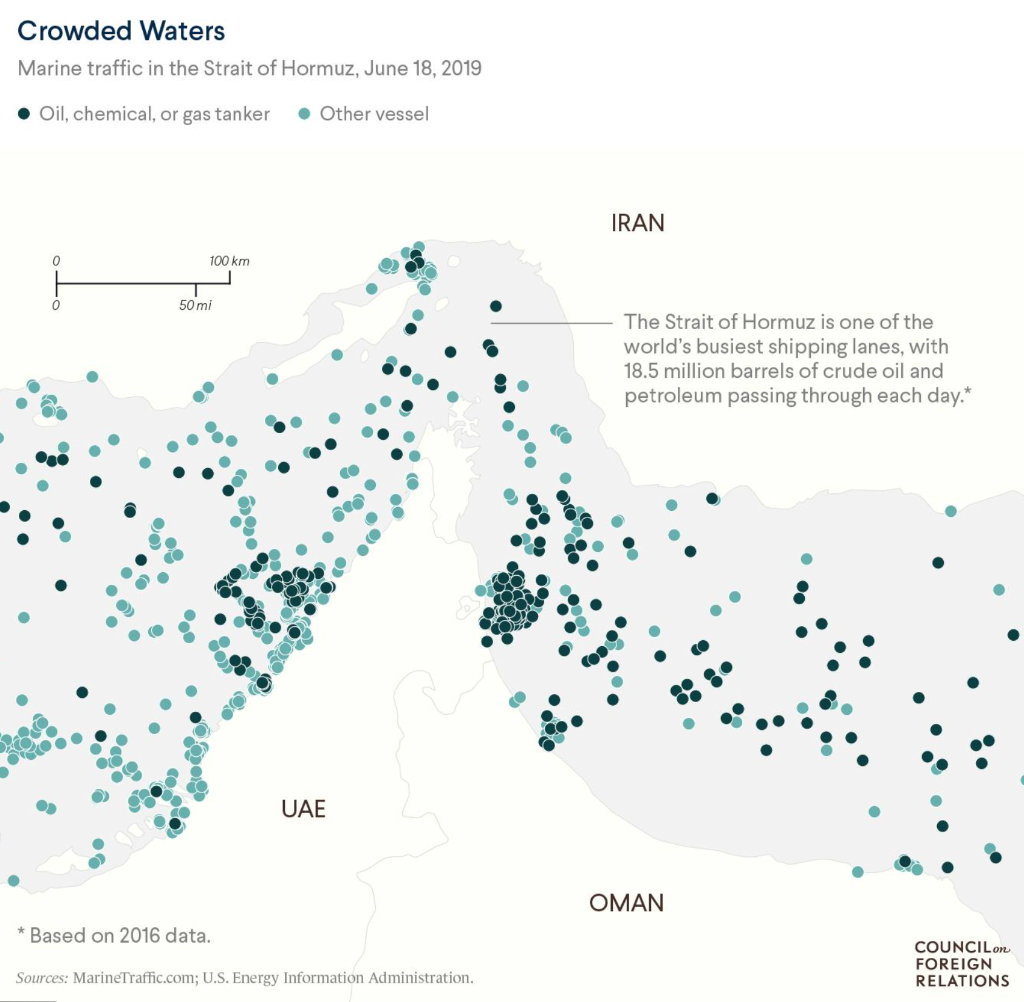 Figure 1: Marine traffic mapping in the Strait of Hormuz. Reopening the Strait is critical to restoring normal flows of roughly 18.5 million barrels of crude and petroleum daily. Source: Council on Foreign Relations.
That uncertainty is exactly why the U.S. Energy Information Administration still expects Brent crude to average around $105 per barrel through much of the summer before gradually easing.
Source: https://www.eia.gov/outlooks/steo/report/global_oil.php
For oil and gas operators, that is probably the best-case scenario. Prices remain strong enough to support drilling activity while avoiding the type of spike that risks pushing the global economy into recession.
The story becomes even more interesting when looking beyond this year. OPEC released its World Oil Outlook this week and projected that global oil demand will climb to roughly 124 million barrels per day by 2050, while overall energy demand rises another 23%.
Source: https://www.opec.org/pr-detail/1854607-18-june-2026.html
In other words, despite years of headlines about the energy transition, the world's largest oil-producing nations still see decades of growing demand ahead.
That long-term outlook is one reason investors continue pouring money into energy assets, even while oil prices swing wildly from week to week.
 Figure 2: Map of the Strait of Hormuz showing the density of tanker traffic and crucial passage routes. Source: Bloomberg / AFP.
Wall Street's New Worry: Interest Rates
While energy investors focused on Iran, Wall Street spent the week focusing on the Federal Reserve.
In his first major meeting as Fed Chairman, Kevin Warsh signaled that another rate hike remains possible this year. Markets did not love the news.
Source: https://www.schwab.com/learn/story/stock-market-update-open
Bond yields climbed to their highest levels in nearly a year as investors recalculated the odds of higher borrowing costs.
Source: https://www.blackrock.com/us/individual/insights/blackrock-investment-institute/weekly-commentary
The concern is simple. Higher rates make everything more expensive, from mortgages and equipment financing to private equity deals and energy acquisitions.
For independent operators raising capital, the cost of money remains just as important as the price of oil.
AI, SpaceX, and the Infrastructure Trade
One thing Wall Street still agrees on is artificial intelligence.
AI continues driving investment across semiconductors, cloud infrastructure, power generation, and data centers. The anticipated SpaceX IPO only added more fuel to the excitement.
Source: https://blog.carnegieinvest.com/monthly-market-commentary-june-2026
The interesting part for Wildcatter readers is that AI is becoming an energy story.
Data centers require enormous amounts of electricity.
Electricity requires generation.
Generation requires fuel.
Which means natural gas, pipelines, transmission infrastructure, and power assets continue benefiting from trends that have nothing to do with oil prices.
What It Means for Mineral Owners
If there was a clear winner from the Iran conflict, it was royalty owners.
Oil prices surged into the $105 to $117 range during the height of the crisis, creating a windfall for mineral owners throughout Texas, New Mexico, Oklahoma, and other producing regions.
The Permian Basin Royalty Trust reported higher distributions this week, citing stronger commodity prices and increased production volumes.
Source: https://www.sec.gov/Archives/edgar/data/0000319654/000119312526275228/pbt-ex99_1.htm
The question now is how long that tailwind lasts.
If the Strait reopens quickly and Iranian production returns faster than expected, royalty checks could gradually shrink over the next year.
If implementation drags into 2027, today's elevated pricing environment could persist much longer than markets currently expect.
Meanwhile, demand for mineral rights remains strong. Buyers continue paying aggressive prices for quality acreage, particularly in the Permian Basin, where production growth and operational efficiencies continue attracting capital.
Source: https://worldoil.com/topics/north-america/u-s-onshore/permian-basin/
Around the World
The Iran agreement was not the only geopolitical story this week.
Israeli Prime Minister Benjamin Netanyahu stated that Israel would not withdraw from Lebanon despite provisions connected to the broader regional agreement. At the same time, Ukraine struck the Moscow Oil Refinery while continuing its path toward European Union membership.
Source: https://www.democracynow.org/2026/6/16/headlines
Back in the United States, the Department of Homeland Security announced plans to expand access to facial-recognition technology used by immigration enforcement agencies, creating another debate over security, privacy, and federal authority.
Source: https://www.npr.org/sections/news
And if you needed a break from politics, the U.S. men's national soccer team remained unbeaten in World Cup group play after another strong performance against Australia.
Source: https://www.npr.org/sections/world
Five Links Worth Reading This Weekend
Iran Deal and Strait of Hormuz Timeline https://www.pbs.org/newshour/world/even-with-a-deal-to-reopen-the-strait-of-hormuz-it-could-take-weeks-or-months-for-oil-to-fully-flow
EIA Global Oil Outlook https://www.eia.gov/outlooks/steo/report/global_oil.php
OPEC World Oil Outlook 2026 https://www.opec.org/pr-detail/1854607-18-june-2026.html
Federal Reserve and Market Update https://www.schwab.com/learn/story/stock-market-update-open
Permian Basin Royalty Trust Distribution Report https://www.sec.gov/Archives/edgar/data/0000319654/000119312526275228/pbt-ex99_1.htm
Bottom Line
The biggest story this week was not that a peace deal was signed.
It was that the entire market immediately began trying to price what comes next.
For operators, mineral owners, brokers, and investors, the question is no longer whether oil supply returns.
The question is how quickly.
And the answer may determine the second half of 2026.